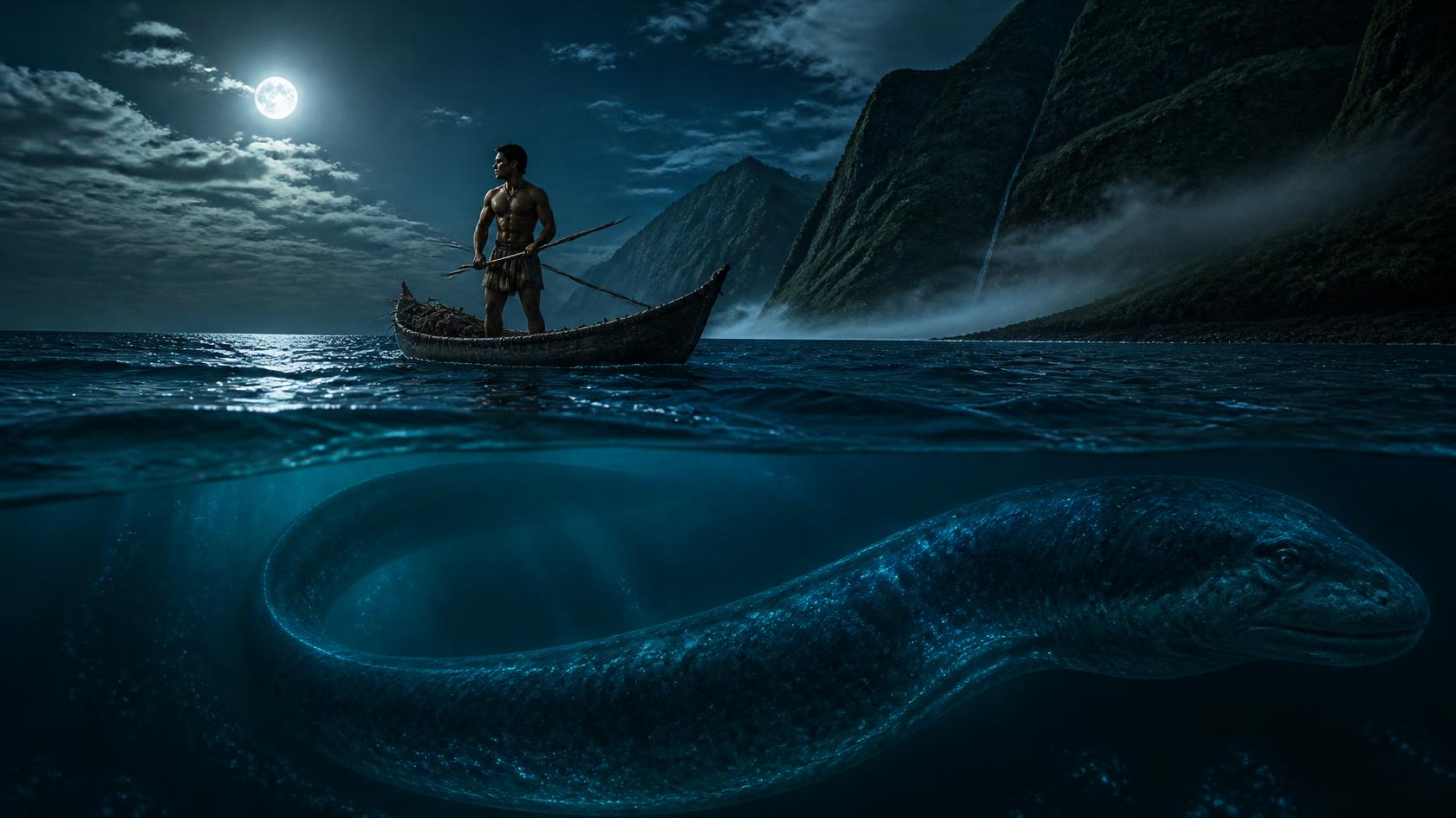
Long ago, when the islands of Hawaiʻi were home to great chiefs, skilled fishermen, and stories of extraordinary beings, a young boy named ʻAiʻai lived with his parents in Hāna, on the island of Maui.
His father, Kūʻulakai, was a respected fisherman. His mother, Hinapukuiʻa, cared for their household. Together, they lived close to the ocean, where the sound of waves breaking against the shore was as familiar as the voices of family.
ʻAiʻai was clever and curious. He wanted to learn everything his father knew about fishing, but Kūʻulakai rarely allowed him to help.
So the boy watched. He watched how his father cared for fish, how he worked around the pond, and how he prepared to provide food for their chief.
ʻAiʻai did not yet know that all those quiet hours of watching were preparing him for a challenge greater than anything he had imagined.
This is the moʻolelo of ʻAiʻai and Koʻona, the mighty eel whose hunger threatened a fishpond and whose story became part of the rocky shores of Hāna.
The Boy Who Wanted to Learn
Every day, ʻAiʻai watched his father work.
When Kūʻulakai tended the fishpond, ʻAiʻai sat nearby and paid close attention. When his father fed the fish, the boy watched the movements of his hands and the ripples spreading across the water.
When Kūʻulakai carried fish to Kahoaliʻi, the high chief of Hāna, ʻAiʻai waited alone on the shore until his father returned.
He often imagined what it would be like to stand beside his father and help with the work.
But whenever he asked, Kūʻulakai told him to sit and watch.
And so ʻAiʻai watched.
He learned to notice small things. He noticed how the water changed when the fish moved beneath its surface. He noticed where the fish gathered and how the pond's walls held the water in place.
Although his father had not given him permission to help, ʻAiʻai was learning more than anyone realized.
He waited patiently for the day when his father would finally trust him with an important task.
The Fishpond of Kūʻulakai
Kūʻulakai had an ambitious plan.
He wanted to build a fishpond where fish could be raised and cared for, providing a steady supply for his household and for Kahoaliʻi, the chief of Hāna.
The pond would have strong walls made from stone. Its measurements were carefully planned, and an opening called a makahā would be built into one of the walls.
The makahā was a gate through which fish could swim into and out of the pond. With the opening arranged properly, Kūʻulakai could manage the movement of the fish.
He worked to make the walls strong enough to hold the water and keep the pond in good condition.
ʻAiʻai watched every step of the work.
He wanted to carry stones, help with the gate, and learn how to care for the fish. But his father continued to tell him to watch from the side.
The pond became an important part of their lives. Its fish helped feed the people and fulfill the responsibilities Kūʻulakai had to his chief.
For a time, everything went well.
The water remained within the walls, the fish swam through the pond, and Kūʻulakai continued his work.
Then, one morning, everything changed.
The Mystery in the Morning
One morning, Kūʻulakai awoke before the sun had fully risen.
The sky was still quiet, and the early light rested softly over the land as he made his way toward the fishpond.
Unknown to him, ʻAiʻai had secretly followed.
The boy wanted to see his father at work and perhaps discover something new about the pond.
But when Kūʻulakai reached the water, he stopped.
Something was terribly wrong.
The makahā had been destroyed. The walls on either side of the gate had broken apart, leaving the fishpond damaged and vulnerable.
Kūʻulakai stared at the wreckage.
Who could have done such a thing?
What creature could have broken through walls that had taken so much work to build?
His anger grew as he examined the damage. The pond he had worked so hard to create had been torn apart during the night.
Later, Kūʻulakai heard the story of what had happened.
A great eel had entered the pond and eaten so many fish that its body had grown enormous. When it tried to leave through the narrow makahā, its huge body had smashed the walls apart.
The eel had a name.
It was called Koʻona.
A Mission for ʻAiʻai
The following morning, Kūʻulakai called his son to join him at the damaged fishpond.
Together, they sat beside the broken walls while the morning breeze moved across the water.
For a moment, Kūʻulakai was quiet. Then he turned toward his son.
"My son," he said, "I have learned what destroyed our fishpond."
ʻAiʻai listened carefully.
"A great eel entered the pond during the night. It ate so many fish that its body became too large to pass through the makahā. When it tried to escape, it broke the walls."
Kūʻulakai paused before continuing.
"The eel comes from Wailau, on the island of Molokaʻi. Its name is Koʻona. But this is no ordinary eel. It is a supernatural being, and it can also take the form of a chief of Molokaʻi."
ʻAiʻai's eyes widened. He had heard stories of powerful beings, but he had never been asked to face one himself.
Then Kūʻulakai said something his son had long hoped to hear.
"I want you to help me, ʻAiʻai. Go to Wailau and find Koʻona. Catch him and bring an end to the trouble he has caused."
At last, his father was trusting him with an important task.
ʻAiʻai felt a rush of happiness and excitement. He would finally have the chance to prove what he had learned.
But he also understood that the journey would be dangerous. Koʻona was powerful, and the sea could be unpredictable.
His father handed him the tools he would need: a thick cord made from hau, a wooden stick to protect the cord from the eel's teeth, a coconut for bait, and a remarkable fishhook called Mānaiakalani.
With these things, ʻAiʻai would travel to Molokaʻi and face the great eel.
Across the Ocean to Wailau
ʻAiʻai knew that he could not make the journey alone.
He gathered companions who could help him paddle a canoe across the ocean from Hāna, Maui, to the distant shores of Molokaʻi.
Together, they prepared for the voyage.
They carried the thick hau cord, the protective stick, the coconut bait, and the magic hook Mānaiakalani.
Then they pushed their canoe into the sea.
The paddles dipped into the water again and again, carrying them away from Maui. The familiar shoreline grew smaller behind them as they traveled toward Molokaʻi.
Along the way, the paddlers remembered something important.
Koʻona was not simply a dangerous animal. He was regarded as a supernatural family guardian by the people of Molokaʻi. The island was also known in traditional stories for its powerful sorcery.
Their destination was Wailau, a rugged place known for its steep cliffs and deep ocean waters.
The paddlers continued onward.
At last, they reached the great cliffs of Wailau and approached a sea cave where Koʻona was believed to live.
The canoe rose and fell with the swells. Dark water moved beneath the cliffs, and the cave waited ahead.
ʻAiʻai leaned forward to study the water.
He had come a long way, and now it was time to put his knowledge to the test.
Mānaiakalani and the Hidden Cave
As the canoe floated near the sea cave, ʻAiʻai chewed some kukui nuts.
He spat the chewed nuts onto the surface of the water.
Something remarkable happened.
The water where the nuts landed became calm, flat, and clear.
ʻAiʻai leaned over the side of the canoe and peered into the depths.
Through the clear water, he could see the place where Koʻona lived.
The hidden home of the great eel had been revealed.
ʻAiʻai prepared Mānaiakalani, the magic hook his father had given him. He secured it to the wooden stick and attached the thick hau cord.
He placed the coconut bait on the hook.
He also took a heavy stone weighing about twenty pounds. The stone would help him sink quickly beneath the surface and reach the deeper water where Koʻona lived.
The paddlers watched him prepare.
ʻAiʻai turned to them and explained what they must do.
"I will dive here. When the hau cord becomes tight, you will know that Koʻona has taken the bait on Mānaiakalani. Then pull with all your strength."
His companions listened carefully.
ʻAiʻai took a deep breath, gripped his equipment, and prepared to enter the water.
Below him lay the dark cave, the hidden home of a being powerful enough to destroy a stone fishpond.
With one final breath, ʻAiʻai dived.
The heavy stone carried him swiftly beneath the waves.
The Cord Grows Tight
Above the surface, the paddlers waited.
The canoe rocked gently on the swells. The cliffs stood tall around them, and the ocean stretched away in every direction.
Nobody spoke.
All eyes remained fixed on the hau cord disappearing beneath the water.
Below, ʻAiʻai had reached the depths near Koʻona's cave. He presented the baited hook and waited for the great eel to take it.
Time passed.
The paddlers waited so long that the silence seemed to stretch endlessly across the ocean.
Then, without warning, the cord jerked.
A moment later, it pulled tight.
"Pull!" the paddlers seemed to shout with their actions as they seized the line and leaned back with all their strength.
The cord strained in their hands.
They pulled and pulled, careful not to lose their grip.
At last, ʻAiʻai surfaced and climbed back into the canoe.
He had survived the dive.
But he was not finished yet.
The great eel was hooked, and the line was still in his hands.
ʻAiʻai ordered his companions to paddle swiftly toward Hāna.
The paddlers turned the canoe toward Maui and began their journey home.
Behind them, Koʻona was being dragged through the sea.
The struggle between the young fisherman and the supernatural eel had begun in earnest.
The Return to Hāna
The canoe raced across the water toward Maui.
The paddlers worked together, moving their paddles in steady rhythm as they pulled the canoe and the enormous eel behind them.
ʻAiʻai held tightly to the hau cord.
He knew that if the line slipped away, Koʻona might escape back into the ocean.
At last, the familiar shores of Hāna came into view.
The canoe approached the landing at Lehoʻula, near the place where Kūʻulakai's fishpond had been damaged.
The travelers reached the shore.
ʻAiʻai jumped out of the canoe, carrying three stones that he intended to use to kill the eel.
His companions stepped back when they saw Koʻona clearly.
The creature's enormous jaws were filled with sharp, pointed teeth. Even on shore, the great eel looked frightening.
The paddlers had helped bring Koʻona all the way from Molokaʻi, but now they watched cautiously from a distance.
ʻAiʻai stood before the creature.
He had traveled across the ocean, dived into deep water, and caught a supernatural eel with a magic hook.
Now he needed to finish the task his father had given him.
Three Stones for Koʻona
ʻAiʻai picked up the first stone.
He aimed carefully and threw it at Koʻona.
But the great eel was not defeated.
ʻAiʻai reached for the second stone.
Again, he threw it with all his strength.
Still, Koʻona lived.
The people watching from the shore waited anxiously.
ʻAiʻai had come too far to give up now. His father had trusted him, and the fishpond needed protection.
He took the third stone into his hands.
He steadied himself and made his final throw.
This time, the great eel was killed.
The shore grew quiet.
The supernatural creature that had traveled from Molokaʻi to feed in the fishpond of Hāna had finally been defeated.
ʻAiʻai had completed his mission.
His courage, careful preparation, and determination had carried him through a challenge that few would have dared to undertake.
The Backbone That Became Stone
After Koʻona was killed, ʻAiʻai and his companions stood beside the great eel's body.
They had witnessed an extraordinary struggle, and they had helped bring a dangerous creature to shore.
Then something even more mysterious happened.
Before their eyes, Koʻona's backbone changed into stone.
The people looked upon the strange remains with wonder.
The backbone of the supernatural eel was no longer simply part of a creature that had lived beneath the waves.
It had become stone, joining the rugged landscape of Hāna.
According to the moʻolelo, the stone backbone could still be seen along the shore where it had come to rest.
And so the story of Koʻona became connected to a real place, a place where people could look at the stones and remember the tale of the great eel.
The ocean had given up its mysterious visitor, and the shore had become the keeper of the story.
The Wisdom of ʻAiʻai
Think back to the boy who sat beside his father and watched him work.
For a long time, ʻAiʻai had wished he could help with the fishpond. He had watched quietly while Kūʻulakai fed the fish, cared for the walls, and carried fish to the chief.
Those hours had seemed ordinary at the time.
Yet they had helped prepare ʻAiʻai for the moment when his father finally trusted him with a great responsibility.
ʻAiʻai did not succeed by rushing into danger without a plan. He gathered companions, prepared his equipment, studied the water, and listened carefully to his father's instructions.
He also understood that some tasks required the help of others. His companions paddled across the ocean, held the line, and brought the eel back to shore.
Together, they accomplished what none of them could have easily done alone.
The moʻolelo reminds us that learning does not always begin with doing. Sometimes it begins with watching, listening, asking questions, and paying attention to the world around us.
Patience can become knowledge. Knowledge can become preparation. And preparation can give us the confidence to face difficult challenges.
ʻAiʻai's journey also reminds us of the close relationship between the people of Hawaiʻi and the ocean. The sea provided food, connected islands, and held stories about powerful beings and the places they inhabited.
Through stories such as this one, the names of places and the knowledge of earlier generations continue to be remembered.
That evening, the sun sank toward the horizon beyond the waters of Maui.
The waves rolled gently against the shore at Hāna, washing over the stones and slipping back into the sea.
ʻAiʻai had returned from his journey. The great eel Koʻona had been defeated, and the story of their encounter would live on in the place where the eel's backbone had become stone.
Perhaps, as night settled over the island, ʻAiʻai thought about his journey across the ocean, the dark water beneath the cliffs of Wailau, and the moment the hau cord had suddenly pulled tight.
He had been a boy who wanted to help his father. Now he had faced a great challenge and returned home having completed the task entrusted to him.
Beyond the shore, the ocean stretched into the darkness. Fish moved through the reefs, currents flowed beneath the moonlight, and the cliffs of Molokaʻi stood far away across the water.
The islands held their stories, and the stories held the memories of those who had come before.
And as the stars appeared above Hawaiʻi, the waves continued their quiet song along the shore.
Sometimes the greatest lessons come from watching carefully, learning patiently, and finding the courage to act when the time is right.
Good night. E moe mālie.
About This Moʻolelo
This bedtime retelling is based on the story of ʻAiʻai retold by Kāwika Napoleon, illustrated by Brook Parker, and edited by William H. Wilson and Hōkūlani Cleeland.
The original story was published in 1993 by ʻAha Pūnana Leo, Inc., in Hilo, Hawaiʻi.
The published account draws on Hawaiian traditions recorded in sources including Martha Warren Beckwith's Hawaiian Mythology, Abraham Fornander's Hawaiian Antiquities and Folklore, Dennis Kawaharada's Hawaiian Fishing Legends, David Malo's Hawaiian Antiquities, and Mary Kawena Pukui's ʻŌlelo Noʻeau.
This adaptation simplifies and reshapes the supplied narrative for bedtime reading by children ages 8–12. Its principal characters, events, and traditional elements are drawn from the supplied account.
Hawaiian names and terms are retained throughout. A makahā is a gate in a fishpond, and moʻolelo refers to a story, history, or traditional account.
This retelling is intended for educational and storytelling purposes. The original published work is protected by copyright; consult the rights holder for permission to reproduce or distribute the original text.
Original story credits: Retold by Kāwika Napoleon. Illustrated by Brook Parker. Edited by William H. Wilson and Hōkūlani Cleeland.