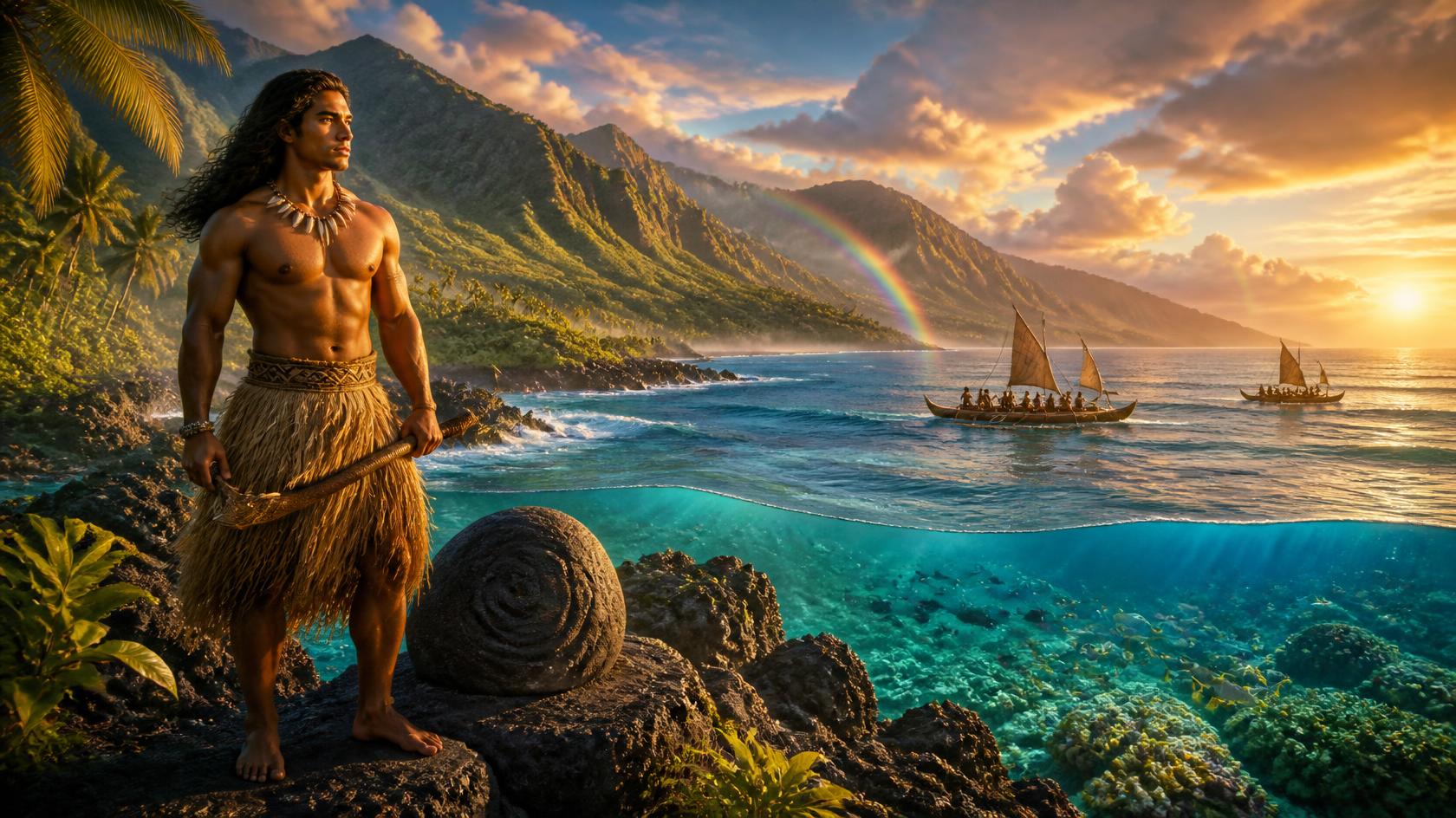
Long ago, when the knowledge of the sea was carried from one generation to the next, there lived a young man named Aiai.
He was the son of Ku-ʻula, whose name was remembered throughout Hawaiʻi as that of a powerful being connected with the fish of the ocean.
Aiai had inherited more than his father's name.
He had inherited his knowledge.
He knew the fishing grounds hidden beneath the waves. He understood where fish gathered, where fishermen should cast their lines, and where the sea floor would hold a hook safely instead of swallowing it among rocks and coral.
But Aiai did not keep this knowledge for himself.
He traveled from place to place, teaching people how to fish, where to find the fish, and how to care for the places that fed them.
And wherever Aiai went, the people remembered him.
The Stone of Victory
After the death of the king of Hana, Aiai left the people of Haneoo and traveled toward Kumaka, near Hamoa.
There, fresh water rose from the sand and rocks near the surf of Puhele.
A large, long stone lay in the sea nearby.
Aiai approached the stone.
Then he lifted it.
With his strength, he raised the stone upright and placed other stones around the spring.
He looked upon the work and spoke to his friend.
"Today I name this stone Ku-lanakila, for I have triumphed over my enemies."
Then Aiai made a declaration.
"Let the fishes, crabs, and sea-moss return in plenty to the seas of Hana, as they were when my parents lived at Lehoula."
From that time onward, the people of Hana remembered the stone.
They said that the fish returned to their waters.
And the stone remained.
Generations later, people still came to see it.
They came to the spring at Kumaka. They bathed in its fresh water and in the surf of Puhele, just as people had done long before them.
The stone became known as a ku-ʻula, a place connected with the abundance of fish.
But this was only the beginning of Aiai's work.
The Knowledge of the Fishermen
Aiai stayed with the people of Hana.
He watched the fishermen work.
Then he began to teach.
He taught his friend and his friend's parents how to make the many kinds of nets used for fishing.
He taught them how to make different fishing lines.
He showed them how different fish required different ways of fishing.
When they had learned the knowledge well, Aiai called the people together.
He stood before them and named his friend the head fisherman of Hana.
The fishing stations, or koʻa ia, that Aiai had established would now be under his friend's care.
Aiai was not simply giving away fishing places.
He was giving away knowledge.
And by teaching another fisherman, his own knowledge would continue after he was gone.
His first fishing station was near Aleamai, the place of his birth.
It was called Kapukaulua.
There, Aiai had measured the depth of the sea and hooked the great eel Koona.
Another fishing station was established for kala, palani, nanue, puhi, and ula.
These fish were caught not simply with nets or hooks, but with baskets filled with bait and lowered into the deep sea.
Farther out was another station called Koauli.
It was deep.
Very deep.
The fishermen had to use landmarks along the shore to find it, because even a small mistake could take them over a rocky bottom where their hooks would catch.
But the fishing grounds Aiai established were carefully chosen.
The hooks would return safely.
The lines would not become tangled among coral.
The fishermen could work with confidence.
The people believed that Aiai's skill came from the knowledge and influence of his father, Ku-ʻula.
The Fish Stone of Kauiki
One day Aiai traveled to Wananalua, the bay that would become known as the port of Hana.
Above the bay stood the famous hill of Kauiki.
Below it stretched the sandy beach of Pueokahi.
Aiai knew this coast well.
He established another ku-ʻula.
Then he placed a fish stone in the cliff of Kauiki.
The fishing ground there became known as Makakiloia.
The people of Hana watched the sea.
When schools of akule, oio, moi, and other fish appeared in their waters, they remembered the stone Aiai had placed there.
Aiai continued along the coast.
At Honomaele, he picked up three small pebbles from the shore.
He carried them into the sea, beyond the breaking surf, and placed them in the water.
At first, they were only three pebbles.
But in time, other stones gathered around them.
Slowly, a ridge formed beneath the sea.
Then the aweoweo began to gather there from the far ocean.
They came to rest along the ridge of stones.
And when the fish arrived, the fishermen knew where to go.
They came with nets, hooks, and lines.
The fishing ground became a place of abundance.
The Giant ʻHeʻe
After spending many days teaching the people of Hana, Aiai prepared to leave.
But before he went, he gave his friend one final challenge.
Out in the deep sea near Wailuanui lived a great heʻe kupua—a supernatural octopus of enormous power.
Aiai told his friend to go and catch it.
The friend agreed.
The canoes were prepared.
The fishermen gathered their equipment.
And before they left, Aiai brought out the hokeo, a fishing gourd.
Inside it was something precious.
It was the leho, a beautiful shell that Ku-ʻula had given to Aiai.
The shell was called Lehoula.
The people of Hana would later remember the shell in the name of the place called Lehoula.
Aiai handed the gourd to his friend.
Then the canoes sailed.
They traveled along the coast until they reached the cliffs near Kopiliula, where they stopped to rest.
Aiai was not with them.
He watched from the cliffs of Puhiai.
Below him, the fishermen prepared the shell.
Aiai's friend called upon Ku-ʻula and Hina for their wonderful powers.
Then he opened the gourd.
The shell inside shimmered with rich colors like a rainbow.
He attached the leho to the fishing line.
Slowly, he lowered it into the deep water.
Beneath the waves, the shell began to shine.
Its light spread through the darkness.
Something moved below.
The fishermen waited.
Then the great heʻe appeared.
Its arms rose from the sea.
They were enormous—long and powerful, rising above the water like the trunks of a grove of coconut trees.
The fishermen were frightened.
The creature came toward the canoes.
It wanted the shining shell.
The fishermen held their ground.
At the right moment, Aiai's friend took the stone he had prepared and pushed it into the head of the great heʻe.
The stone pulled downward.
The creature sank.
Deeper.
Deeper still.
The great heʻe could not free itself from the weight.
At last, it died.
The fishermen seized one of its enormous arms.
It was so large that the single arm filled the canoes.
They returned to Hana carrying their catch.
Far above them, Aiai saw that his friend had succeeded.
He returned to Hana unseen.
Later, the people divided the great arm according to Aiai's instructions.
The story says that when the great heʻe died, it became stone.
And even generations later, people could point to the stone formation outside Wailuanui and see the shape of the creature and its arms, with one missing.
The Journey Begins
Aiai had accomplished what he came to do.
The people of Hana had learned the arts of fishing.
They knew their fishing grounds.
They knew how to make their nets and lines.
They knew where the sea floor was safe for their hooks.
Now Aiai felt it was time to continue his journey.
He called his friends together.
He told them that he would travel to other places and teach other people the same knowledge.
His friends thanked him for everything he had given them.
Then Aiai left Aleamai.
He carried with him the fish-hook Manaiaakalani.
He also carried the fish pearl Kahuoi, which he had taken from the little cave where he had once stayed on Kaiwiopele.
Then, in the mysterious way remembered in the stories of his parents, Aiai disappeared from Hana.
But he did not stop traveling.
From Hana toward Kipahulu, he established more ku-ʻula and koʻa ʻāina.
At the streams of Kikoo and Maulili, he placed stones.
One of those stones fell at a bend in the water.
Floods swept through the valley again and again.
But the stone remained.
Farther out in the sea of Maulili was a famous fishing station called Koanui.
Aiai knew where it was.
He knew the water.
He knew the fish.
And he knew the fishermen who would one day depend upon that place.
The First Fish
One day Aiai was fishing at Koanui.
He was floating on a simple craft made from a wiliwili log.
There was no outrigger.
A fisherman named Kanemakua saw him and paddled closer.
Kanemakua was drifting without much luck.
Then Aiai felt a tug on his line.
A fish was on the hook.
Aiai pulled it in.
When Kanemakua came close enough to speak, Aiai greeted him and placed the fish into his canoe.
Kanemakua was delighted.
He thanked Aiai for his generosity.
But Aiai had something more to give him.
"This is the first time I have fished in these waters to establish this station."
"You are the first man I have met here, so I give you the first fish."
Then Aiai gave Kanemakua responsibility for the fishing ground.
But before he left, Aiai gave him advice.
"When you come here to fish and see a man floating beside you in a canoe, if you have caught a fish, give it to him as I have given this fish to you."
"Give it without regret."
"Then you will be known as a generous man, and good things will come to you and to those connected with you."
Kanemakua listened carefully.
Then Aiai disappeared.
Kanemakua looked around.
For a moment, he wondered whether he had dreamed the whole thing.
But there, in his canoe, lay the great fish Aiai had given him.
Kanemakua returned to shore.
The fish was so large and heavy that two other people had to help him carry it home.
When the fish was cooked, Kanemakua offered its eyes in thanksgiving.
Then his family, friends, and neighbors gathered around the food.
They ate together.
And while they ate, Kanemakua kept thinking about Aiai's words.
He remembered the first fish.
And he remembered that a good name could be built one generous act at a time.
Across Maui
Aiai continued his journey.
He traveled through Kaupō and onward to Kahikinui.
There, fishing stations reached into the deep sea.
Fishermen used different kinds of nets, poles, and lines.
The ku-ʻula themselves were placed along the shore.
Aiai continued toward Honuaʻula.
He crossed the waters toward Kahoʻolawe.
At Hakioawa, he established a ku-ʻula unlike the others.
It stood high above the sea.
Stones were arranged in a square, leaving an open space in the center.
There, fishermen could place their first fish as an offering of thanks.
Awa and kapa were also placed there as offerings to the fish deities.
Aiai's work was spreading.
Everywhere he traveled, he left behind places where people could fish and knowledge that could be passed to the next generation.
The Pearl of Kaunolu
From Kahoʻolawe, Aiai traveled to Lānaʻi.
At Cape Kaunolu, he began fishing for aku, using his fish pearl, Kahuoi.
The aku was a deep-sea fish.
It was not normally caught from land.
Yet Aiai used the pearl from shore.
The story remembers this as the beginning of fishing for aku from that place.
Aiai continued around the island.
Then he came to Kaʻena Cape.
Near Paomai was a small sandy beach, a place now known as Polihua.
There Aiai took a stone.
He carved a figure into it.
Then he carried the stone to the beach and placed it upon the sand.
Aiai called upon his parents.
He spoke his incantations.
Then something strange happened.
The stone began to move.
Slowly, it traveled toward the sea.
Then it disappeared beneath the water.
Aiai finished his incantations.
The stone appeared again.
It moved back toward him.
When it reached the place where Aiai had first laid it, the stone changed.
It became a turtle.
And the beach became known as Polihua.
The story remembers this moment as the beginning of the turtle's presence in the seas of Hawaiʻi and the beginning of the turtle's habit of coming onto the beach to lay its eggs before returning to the sea.
The Ladder of the ʻOpae
Aiai crossed the water again.
This time he came to Molokaʻi.
He landed at Punakou and traveled along the shore until he reached Kaunakakai.
Then he continued along the island.
At Wailau, on the windward side of the island, Aiai saw something that troubled him.
People were gathered along the valley.
Men, women, and children were closing off the stream and turning its water into another channel.
They were trying to catch ʻōopu and ʻopae.
Their gourds were already full.
Yet they continued catching everything they could.
Aiai watched.
He saw that they were leaving nothing behind for the fish and shrimp to continue their generations.
This was not the careful fishing knowledge he had been teaching.
Aiai called upon his parents.
Then the water changed.
The fish and shrimp suddenly disappeared.
Those in the stream moved upstream toward a place called Koki.
Those already caught in the gourds changed into lizards and hurried away across the rocks.
The people stared.
Their food was gone.
But Aiai felt compassion for a young boy named Kahiwa.
He showed Kahiwa where the ʻōopu and ʻopae had gone.
They were high above the valley, near the steep cliff of Koki.
Kahiwa listened.
He climbed.
And there he found the fish and shrimp.
From that story came the old saying that Koki of Wailau was the ladder of the ʻopae.
The cliff also became known as the Pali of Kahiwa.
Before Aiai left Wailau, he showed Kahiwa the fishing ground he had established offshore.
Then he continued his journey.
He traveled through Pelekunu, Waikolu, Kalawao, and Kalaupapa.
At Kalaupapa he left a fish stone.
The people remembered that fish gathered there.
Aiai continued onward, following the coastline and leaving his knowledge behind him.
Across the Sea to Oʻahu
At last, Aiai came to Oʻahu.
He first landed at Makapuʻu.
There he established a fish stone called Malei.
It was a female rock, and the fish associated with the place was the uhu.
The fishing place extended toward Hanauma.
Aiai continued along the coast.
He traveled to Maunalua, then to Waiʻalae and Kahalaia.
At Kaalawai he placed a white and brown rock.
Nearby was a hole filled with aholehole, and the place became known as Kaluahole.
At Kahuahui, Aiai placed another large round sandstone.
Around it were places where fish gathered.
It was called Ponahakeone.
Aiai continued westward.
At Kakaʻako he met a man named Apua.
Aiai stayed with him for several days.
There he listened to the sounds of the shore and heard about the chief Kou, a fisherman of great skill.
Kou was famous for fishing for aku outside Mamala.
He was also known for sharing his fish generously with the people.
Aiai had reached another place where fishing knowledge was already deeply respected.
But his journey was not yet finished.
A Son from the Sea
One day Aiai wandered along the shore of Kulolia, then toward Pakaka and Kapapoko.
He did not return to Apua's house.
Instead, he met a young woman named Puiwa.
She was gathering limu and fishing for crabs.
Puiwa lived at Hanakaialama.
She and Aiai went together to her home and met her family.
Before long, they were married.
In time, they had a son.
Aiai named him Puniaiki.
But life in the household was not always peaceful.
Fish were being distributed throughout the area, and while some families received whole fish, Puiwa sometimes received only a portion.
She became frustrated.
One day, she asked Aiai to catch ʻōʻopu and ʻopae from the stream so their family would have food of their own.
Aiai listened.
He dug a ditch and built a dam to guide the water into pits where the fish and shrimp could be caught.
For several days he worked.
Fish and shrimp were caught and hung up to dry.
Then, one day, Aiai and Puiwa brought their young son to the stream.
Puiwa went to the fishing pits.
The child remained on the bank.
Before long, he began to cry.
Aiai heard him.
He told Puiwa to stop fishing and tend to the child.
But she answered him sharply.
Aiai called upon the names of his ancestors.
A dark cloud gathered over the valley.
Then the rain came.
Water rushed down the stream.
The dam broke.
The water swept away the fish and shrimp.
And the child was carried away with them toward the sea.
Puiwa remained on the bank.
Aiai left.
But the story of his son was not over.
The Child in the Calabash
Far from the place where the flood had carried him, the child was found in another form.
At Kaumakapili, women were fishing along the stream.
Among them was the daughter of the chief Kikihale.
A very large ʻōʻopu was caught.
The guardian of Kikihale showed it to her.
Kikihale decided that the fish should be kept alive.
It was placed inside a large calabash filled with water.
The fish was carefully fed with limu.
Day after day, the guardian tended it.
Then, one day, she lifted the lid.
She froze.
The water was gone.
And inside the calabash was a human child.
The woman trembled.
She hurried to tell Kikihale what she had seen.
Kikihale followed her.
She looked into the calabash.
There really was a child.
She lifted him carefully.
Then she made a decision.
"Take this child and raise him until he is grown. Then he will be my husband."
The guardian warned her that the child would one day be young while she was older.
But Kikihale had already made up her mind.
The child was raised.
He grew to adulthood.
And Kikihale kept her promise.
She married him.
His name was Puniaiki.
For a time, they lived together without trouble.
But Puniaiki did not seem interested in helping provide for the household.
Kikihale grew frustrated.
Again and again, she asked him to go fishing and help her father and the people.
At last, her words struck deeply.
Puniaiki answered that he knew how to command fish.
He told her to ask her father for canoes, fishing gear, and men to paddle them.
Kikihale did exactly that.
The Hidden Power
The canoes were prepared.
Nets, lines, rods, and fishing equipment were gathered.
Among the equipment were many pearl fish-hooks belonging to Kou.
Puniaiki looked at them.
Then he built a fire.
One by one, he burned the pearl hooks.
Kikihale was furious.
She hurried to her father and told him what Puniaiki had done.
Kou had supplied five gourds filled with the hooks—nearly a thousand of them.
Almost all were burned.
Only two remained.
But Puniaiki had not destroyed what mattered most.
He was about to discover something that had been waiting for him.
The Rainbow in the Mountain
That night, Puniaiki slept apart from his wife.
He told the canoe paddlers to remain in the canoe sheds until morning.
Before dawn, he woke.
He turned his face toward the mountains.
There, near Kaumakapili, he saw a rainbow.
Beneath the rainbow was a reddish mist.
And within that mist stood a human figure.
Puniaiki knew who it was.
His father.
Aiai had returned.
Puniaiki went to him.
Aiai showed his son the place of the fish-hook called Kahuai.
"Here will I stay until you return. Be quick."
Puniaiki hurried back to the landing.
The canoes were ready.
The paddlers pushed away from shore.
They passed Kapapoko and Pakaka.
They continued across the sea of Kulolia.
At last they reached Ulakua, near the entrance of Honolulu Harbor.
Puniaiki looked toward the breaking surf.
"What is the name of that surf breaking beneath the prow of our canoes?"
The paddlers answered.
"Puuiki."
Puniaiki pointed toward the breakers.
"Point the canoes straight toward it. Paddle with strength."
The men were uncertain.
Why would he send them toward the surf?
There might be no fish there.
But they followed his command.
As they neared the breakers, Puniaiki suddenly ordered them to turn back toward shore.
Then he told them to paddle harder.
They were now over the place where the aku gathered.
The fishermen looked into the water.
They saw nothing.
Then Puniaiki opened the wrapping around Kahuai.
He held the fish-hook in his hand.
The sea changed.
Suddenly the aku appeared in astonishing numbers.
Fish leaped into the canoes.
More came.
And more.
The canoes filled until they began to sink beneath the weight.
The fishermen jumped into the water to help float them toward shore.
People along the beach watched in amazement.
The harbor seemed alive with fish.
The aku moved toward the fishpond of Kuwili and the mouth of Leleo Stream.
Never had the people seen such a catch.
The First Gift
When the canoes reached shore, Puniaiki took two aku in his hands.
Then he went to find his father.
Aiai was waiting.
He told Puniaiki to take the first fish to his mother, Puiwa.
But the fish were not simply gifts.
One was an offering to Ku-ʻula at a fishing place established above Kahuailanawai.
Puniaiki followed his father's instructions.
Then he returned to Puiwa with more aku.
When Puiwa saw the young man standing before her with fish, she was astonished.
She did not yet understand.
The young man was her own son.
The child she had once watched beside the stream had returned in a form she could never have imagined.
Meanwhile, the people of Oʻahu continued marveling at the fish.
Aku filled the harbor.
Even the stream near Kikihale was full of them.
Puniaiki told the people to take the fish day and night.
News of the great arrival of aku traveled throughout Oʻahu.
Kou, the famous fisherman, heard the news.
His son-in-law had accomplished something extraordinary.
But Kou was not angry.
He sat quietly.
He thought about what he had seen.
And he understood that there was knowledge in Puniaiki that even a great fisherman could not ignore.
The Fishing Grounds of Oʻahu
Aiai and Puniaiki now began another part of their work.
Together, they established ku-ʻula, koʻa, and fish stones around Oʻahu.
The Kou stone served Honolulu and Kaumakapili.
A ku-ʻula was established at Kupahu.
A fish stone was placed at Hanapouli in ʻEwa.
Ahuena became the ku-ʻula for Waipiʻo.
Two were established for Honouliuli.
Hani-o was the name of the koʻa outside Kalaeloa.
Kua and Maunalahilahi marked fishing places at Waiʻanae.
Kamalino was established at Waimea.
Kaihukuuna marked the fishing grounds toward Laʻie and Mālaekahana.
Aiai and his son were no longer simply traveling fishermen.
They were carrying knowledge across the islands.
Across the Islands
But Aiai's journey did not end on Oʻahu.
He and Puniaiki traveled onward.
They visited Kauaʻi.
They visited Niʻihau.
Then they turned toward Hawaiʻi Island.
There were many fishing grounds known throughout the island.
At Kona were Poo-a, Kahaka, and Olelomoana.
At Kaʻū was Kalae.
At Puna was Kupakea.
And at Hilo was another fishing ground remembered in the old accounts.
Wherever Aiai traveled, the same work continued.
Find the fishing grounds.
Learn the sea.
Teach the fishermen.
Establish places where fish could gather.
Pass the knowledge onward.
The old stories say that in former times, many of these places were filled with fish of many kinds.
Deep-sea fish sometimes came close to shore.
The fishermen knew where to find them.
And generation after generation remembered the places Aiai had established.
The Knowledge That Remained
Aiai traveled far.
From Hana to Kipahulu.
From Maui to Kahoʻolawe and Lānaʻi.
Across Molokaʻi.
Across Oʻahu.
And onward to Kauaʻi, Niʻihau, and Hawaiʻi.
At each place, he left something behind.
Sometimes it was a stone.
Sometimes it was a fishing ground.
Sometimes it was a lesson.
And sometimes it was a person who had learned enough to teach someone else.
That was Aiai's greatest gift.
He did not keep the knowledge of the ocean locked away.
He passed it on.
A fisherman learned how to make a net.
Another learned how to read the water.
Another learned where a hook could fall safely.
Another learned that a first fish could be given away without regret.
And another learned that the sea could provide for many generations only if people understood how to care for it.
And so Aiai continued on his mysterious journey.
Sometimes the old stories say he appeared in one place and then disappeared from another.
Sometimes he left behind a stone beside the shore.
Sometimes he left a fishing ground far beneath the waves.
And sometimes he left only the knowledge he had placed inside another person's hands.
The stones remained.
The fishing grounds remained.
And the stories remained.
Because the sea remembers.
The mountains remember.
And so do the people who carry the old knowledge forward.
Long after Aiai had disappeared beyond the horizon, fishermen could still look toward the shore, find the landmarks, and know where to cast their lines.
Somewhere beneath the moonlit ocean, the fish moved through the dark water.
The waves rolled toward the beach.
The stones rested where Aiai had placed them.
And the story of Ku-ʻula and his son Aiai continued to be carried from one generation to the next.
"The sea gives its knowledge to those who learn to listen."
The night grew quiet.
The stars shone above the islands.
And far below them, the ocean breathed against the shore.
The story was not gone.
It was simply waiting for the next person to tell it.
Good night.