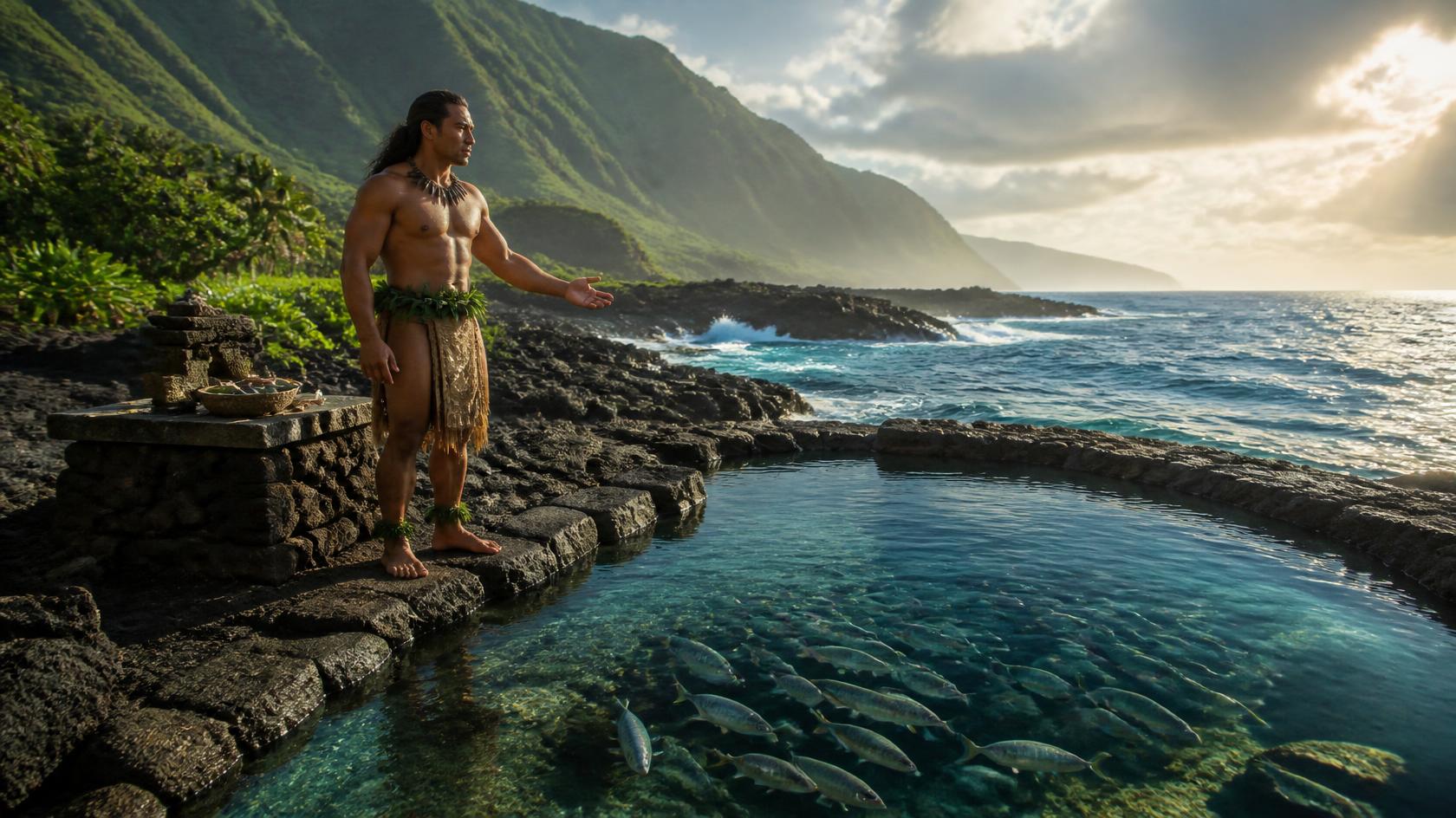
Long before Hawaiʻi's shores were marked by modern harbors and fishing boats, the people of the islands lived in a close relationship with the ocean.
The sea provided food, supported families, and connected one generation to the next. Its currents, reefs, fish, and hidden depths were understood through careful observation, experience, and knowledge passed down from the ancestors.
Within the old Hawaiian traditions, certain beings were remembered for their extraordinary relationship with the ocean and its fish. Among them was Ku-ʻula, a figure whose name became known throughout the Hawaiian Islands.
This is the story of Ku-ʻula, the fish deity of Hawaiʻi, whose miraculous power was said to influence the fish of the sea. It is also the story of his wife, Hina-pu-ku-ia, and their son, Aiai-a-Ku-ʻula, whose courage and knowledge would carry their family's legacy across the islands.
The following narrative is adapted from the historical account titled Ku-ula, the Fish God of Hawaii, translated from Moke Manu by M. K. Nakuina. The account presents the Maui version of the tradition as it was transmitted by the elders.
The One Who Commanded the Fish
In the old days, there lived a remarkable being named Ku-ʻula.
He possessed a human body, yet the traditions said that he held a miraculous power known as mana kupua.
Through this power, Ku-ʻula could direct, influence, and control the fish of the ocean.
He could call upon the fish, and they would appear. He understood the sea in ways that ordinary fishermen could only hope to learn.
His name was remembered on every island of the Hawaiian group. Among the people, Ku-ʻula was regarded as a deity connected with the abundance of fish and the mysterious forces that governed life beneath the waves.
Yet his story did not begin in a great temple or a royal court. It began near the shore of Maui, in the land of Aleamai, in Hana.
The Home at Leho-ula
In Aleamai, Hana, Maui, there was a place called Leho-ula.
It was here that Ku-ʻula and his wife, Hina-pu-ku-ia, made their home.
The old traditions do not preserve the names of their parents. Instead, they remember Ku-ʻula, his wife, their son Aiai, and Ku-ʻula's younger brother, Ku-ʻula-uka.
For a time, the brothers lived together. But eventually, they decided to divide their responsibilities and follow different paths.
Ku-ʻula-uka chose the land.
His work would extend from the seashore upward toward the mountain peaks. He would concern himself with the earth, cultivation, and the things that grew upon the land.
Ku-ʻula chose the sea.
He was also known as Ku-ʻula-kai, and his responsibilities extended from the pebbled shoreline into the deepest parts of the ocean.
The brothers had chosen their paths: one would work with the land, and the other would devote himself to the fish and waters of the sea.
After their separation, Ku-ʻula-uka went into the mountains. There he met a woman named La-ea, also known as Hina-ulu-ohia.
La-ea was a sister of Hina-pu-ku-ia. Together with their three brothers, Moku-ha-lii, Kupa-ai-kee, and Ku-pulu-pulu-i-ka-na-hele, they belonged to a family remembered in the old traditions concerning the sacred arts of canoe making.
The sea and the land now had their own guardians, each following the work to which they had committed themselves.
The Pond That Never Lacked Fish
Ku-ʻula devoted himself to his chosen occupation.
His first undertaking was to construct a fishpond close to his home, near enough to the shore that the surf could be heard breaking upon the rocks.
He stocked the pond with many kinds of fish.
Fish of different varieties and colors moved through the water, filling the pond with life.
Ku-ʻula also built a sacred house upon a rocky platform.
He called this place Ku-ʻula, using his own name for the sacred fishing place associated with his work.
But Ku-ʻula did not simply gather fish for his own enjoyment. According to the traditional account, he believed in a supreme God whose power extended over all things.
Because of this belief, Ku-ʻula prepared a place where he could make offerings of the first fish he caught.
The first fish was not merely food. It was an offering, a recognition that the abundance of the sea was something to be acknowledged with reverence.
The tradition says that after Ku-ʻula established this practice, the fish became completely responsive to his wishes.
He needed only to speak, and the fish would appear.
Word of the remarkable fisherman soon traveled throughout Hana.
The King and His Chief Fisherman
At Wananalua, the land upon which Kauiki Hill stands, lived Kamohoalii, the king mentioned in this version of the tradition.
When the king heard about Ku-ʻula and his extraordinary fishpond, he appointed him as his head fisherman.
This appointment brought Ku-ʻula into a position of great responsibility.
The king's table needed a steady supply of fish. Some varieties were common, while others were rare or difficult to obtain.
Yet Ku-ʻula's pond was filled with different kinds of fish, allowing the king to receive varieties that might otherwise be difficult to find, even when they were not in season.
Ku-ʻula became the king's principal source of fish.
His skill earned him respect, and the king held him in high esteem.
For many years, Ku-ʻula and Kamohoalii lived together without disagreement.
The fisherman served his king, the pond continued to provide its abundance, and Ku-ʻula's reputation spread throughout the surrounding lands.
During these years, another important event took place in Ku-ʻula's household.
His wife gave birth to a son.
They named him Aiai-a-Ku-ʻula: Aiai, son of Ku-ʻula.
The Son of Ku-ʻula
Aiai was raised according to the customs of his people.
He grew within a household where the sea was more than a source of food. It was the realm in which his father worked, taught, and exercised the extraordinary abilities remembered in the old stories.
In time, Aiai became old enough to care for himself.
And when he reached that stage of life, a strange event began to threaten the abundance his father had worked so hard to create.
The fish in Ku-ʻula's pond were disappearing.
At first, the cause was unknown. The pond had been stocked with fish of many varieties, yet its supply was steadily diminishing.
Ku-ʻula was astonished.
He could not understand how so many fish could vanish from a pond that he knew so well.
Rather than ignore the problem, he decided to watch the pond closely.
Night after night, he kept watch. He studied the water and waited for whatever might be entering the pond to steal its fish.
Eventually, near daybreak, he discovered the cause.
Koona, the Great Eel
A large eel had been entering Ku-ʻula's fishpond through its seaward wall.
The eel was called Koona.
Koona was no ordinary creature.
In the traditions of Wailau, on the windward side of Molokaʻi, the eel had been deified and worshipped by the people who lived there.
They told stories of its extraordinary power, including a battle with a great shark.
According to their account, a powerful shark once came to Wailau and fought with Koona.
During the struggle, the eel caused part of a rocky cliff to collapse upon the shark, killing it.
The falling rock created a deep cave, said to measure about five fathoms. The opening was located above the sea, near the rocky stronghold associated with the well-known Kapepeekauila.
Afterward, Koona left its original home and moved to a cave in the sea near Aleamai.
This cave was called Kapukaulua and lay some distance beyond the Alau rocks.
From this hiding place, Koona entered Ku-ʻula's pond and robbed it of its fish.
The mysterious thief had finally been discovered.
Ku-ʻula now knew what was happening, but the question remained: how could such a powerful creature be captured?
Aiai Accepts the Challenge
Ku-ʻula began considering how he might catch and kill the eel.
But after speaking with his wife, Hina-pu-ku-ia, they decided that the matter should be entrusted to their son.
Aiai would be allowed to use his own judgment and decide how the dangerous creature should be captured.
When Aiai learned what had happened, he began preparing for the undertaking.
He sent word throughout Aleamai and Haneoo, asking the people to make long ropes from the fibers of the hau tree.
These ropes needed to be extraordinarily long, for the eel lived far out in the sea.
When the ropes were ready, the people gathered to help.
Two canoes were prepared. One came from Aleamai, and the other came from Haneoo.
Aiai boarded one of the canoes.
He brought two large stones and carried a fisherman's gourd known as a hokeo.
Inside the gourd was a remarkable fishhook called Manaiaakalani.
With the ropes, stones, hook, and canoes prepared, Aiai and the fishermen pushed away from shore.
Their destination was the deep water above Koona's underwater cave.
The Descent into the Ocean
The canoes traveled far from the shore.
Aiai studied the landmarks along the coast, carefully judging their position until he believed they had reached the correct place.
He looked down into the water.
Then he ordered the paddlers to stop.
Standing in the canoe, Aiai took one of the heavy stones into his hands.
And then he dived.
The weight of the stone carried him quickly down through the water.
Below him lay the ocean floor.
As he descended, Aiai discovered a large cave opening directly before him.
Fish moved around the entrance. Among them were ulua and other deep-sea varieties.
Their presence strengthened his belief that Koona was hiding within the cave.
Aiai returned to the surface and climbed back into the canoe.
He rested briefly, then opened the gourd and took out Manaiaakalani.
He tied one of the long hau ropes to the hook.
Next, he prepared a long stick and secured the hook at its end.
The hook was baited with a mixture of coconut and other substances attractive to fish.
Everything was ready.
Manaiaakalani Finds Its Target
Before making his second descent, Aiai explained to the fishermen how they would recognize his success.
He arranged a signal so that the people in the canoe would know when the hook had caught the eel.
Then he picked up the second stone.
Once more, he plunged into the sea.
The stone carried him down toward the dark cave.
Aiai approached the opening and carefully placed the baited hook inside.
As he worked, he murmured incantations in the names of his parents.
The cave lay before him, its entrance surrounded by fish moving through the deep water.
Then the moment came.
Koona had taken the hook.
Aiai knew that the creature was caught.
He gave the signal he had arranged with the fishermen.
Above him, the people waited, watching the line and the water.
Before long, Aiai rose to the surface and climbed into the canoe.
The hook was secured.
The eel had been caught.
Now the challenge passed to the people waiting on shore.
The Pull of the Ropes
Aiai and the fishermen returned toward land, towing the long rope behind them.
Once they reached shore, Aiai gave instructions to both groups of fishermen.
Those from Haneoo were told to paddle to their landing and continue onward to Hamoa. They were to call upon their people and bring them together for the work ahead.
The Aleamai fishermen received similar instructions.
Word spread quickly.
Men gathered from both places. The long ropes were prepared, and many hands assembled to help pull the enormous eel from the sea.
Aiai climbed Kaiwiopele Hill.
From there, he could signal the people gathered below.
He motioned for them to begin pulling the ropes attached to the hook in Koona's mouth.
The people pulled with all their strength.
The eel resisted, and the task demanded the effort of everyone who had gathered.
The tradition remembers that the people of Aleamai, although fewer in number than those from the other places, won the contest.
Through their combined strength, they brought Koona onto the pahoehoe stones at Lehoula.
The great eel had been dragged from its hiding place in the deep ocean to the shore where Ku-ʻula and his family lived.
The End of the Great Eel
The people had succeeded in bringing Koona onto the shore, but the enormous eel was not yet dead.
They tried to kill it.
Their efforts were unsuccessful.
The creature that had robbed Ku-ʻula's pond was still powerful, even after being pulled from the ocean.
At last, Aiai came to finish what the people had begun.
He took three stones known as ala stones.
He threw them at the great eel.
This time, Koona was killed.
The people had overcome the creature that had taken so many fish from Ku-ʻula's pond.
The eel's head was cut off, and it was cooked in an imu, an underground oven.
Its enormous jaws became part of the story that endured long after the event itself.
The traditional account states that the bones of the eel's jaw, with its mouth open, could be seen near the shore, where the waves washed over them.
Nearby, a rock formation bore a striking resemblance to the creature's remains.
For the people who remembered the story, the landscape itself became a reminder of the encounter between Aiai and Koona.
The Legacy of Ku-ʻula and Aiai
The story of Ku-ʻula is more than a tale about a mysterious fisherman who could call fish from the sea.
It is a story about a family whose lives were closely bound to the ocean.
Ku-ʻula established a fishpond, created a sacred place for offerings, and became the chief fisherman for the king of Hana.
His work demonstrated the importance of knowledge, preparation, and respect for the forces believed to sustain the sea.
His son Aiai inherited a world filled with responsibilities. When a powerful eel threatened the fishpond, he did not act carelessly or alone.
He studied the water, recognized the location of the creature's hiding place, prepared the tools he needed, and brought the people together for a difficult task.
His success depended upon patience, planning, courage, and cooperation.
The old account also connects the story to places that were known to the people of Maui and Molokaʻi. Caves, rocky shores, hills, and coastal formations became part of the landscape through which the tradition was remembered.
In Hawaiian fishing traditions, the name ku-ʻula is also associated with sacred fishing places and stones connected with fish abundance. The precise practices and meanings varied across communities and historical periods.
These traditions remind us that fishing was not simply a matter of catching whatever could be found in the ocean.
It required knowledge of the sea, familiarity with the land, the cooperation of the community, and an understanding of one's responsibilities.
Ku-ʻula's name endured because his story connected the people with the fish, the shoreline, and the knowledge passed from one generation to another.
The waves continued to roll onto the shores of Hana.
Beneath the surface, fish moved through the deep water, weaving between rocks and coral.
The hidden cave of Koona remained part of the ocean's mystery, and the rocky coast preserved the places named in the old story.
Ku-ʻula's fishpond had been threatened, but his son Aiai had answered the challenge.
Through his courage and the strength of the people, the great eel was brought to shore.
And the story was carried forward.
From the elders who remembered the old places to the storytellers who preserved their names, the moʻolelo of Ku-ʻula continued to connect the people of Hawaiʻi with their ancestral waters.
The ocean held its secrets, the stones rested beside the waves, and the knowledge of the fishermen lived on in the stories passed from one generation to the next.
The sea was not merely a place to find fish. It was a world of knowledge, responsibility, and connection.
Good night.
About This Moʻolelo
This retelling is based on Ku-ula, the Fish God of Hawaii, translated from Moke Manu by M. K. Nakuina.
The historical account identifies its narrative as the Maui version of the tradition, transmitted through the elders. This web adaptation reorganizes the supplied excerpt into readable sections while retaining the principal events described in that passage.
The supplied excerpt ends during a description of the remains associated with the great eel. This retelling does not claim to reproduce portions of the original source that were not included in the excerpt.
Hawaiian names and terms are retained where possible. Spellings in the historical source sometimes differ from modern Hawaiian orthography.