Long, long ago, before clocks told people when to wake and when to sleep, the days were very different.
The Sun raced across the sky.
He did not walk.
He did not stroll.
He raced.
Every morning, the Sun would leap up from the eastern horizon, blaze across the heavens, and disappear again before people had finished all the work they needed to do.
The days were so short that fishermen could barely finish their work. Farmers struggled to tend their crops. Food was difficult to prepare before darkness arrived.
And there was one person who was especially troubled by the hurried Sun.
Her name was Hina.
Hina and the Rushing Sun
Hina worked hard every day making beautiful kapa, a cloth made by pounding the bark of trees until it became soft and thin.
She would spread the cloth beneath the warm Sun so that it could dry.
But just as the cloth began to warm and dry—
WHOOSH!
The Sun would race away.
Darkness would fall.
Hina would have to gather everything up and wait until the next day.
One evening, she sighed.
"Oh, that Sun! Why must he hurry so?"
Her son, Maui, heard her.
Maui was not an ordinary young man.
He was clever, curious, brave, and—according to the old stories—just a little too fond of getting into trouble.
He looked at his mother.
"Does the Sun do this every day?"
"Every day," Hina replied.
Maui smiled.
"Then I think the Sun needs to learn how to slow down."
Hina laughed.
"You? Slow down the Sun?"
Maui grinned.
"Why not?"
Watching the Sun
Maui knew that if he wanted to change the Sun's journey, he first had to understand it.
So he climbed high into the mountains, where he could see the whole sky spread out before him.
From there, he watched the Sun rise.
He watched where it appeared over the mountains.
He watched the path it followed across the sky.
And he watched the place where it disappeared again at the end of the day.
The next morning, Maui returned.
He watched again.
And the morning after that.
Day after day, Maui studied the Sun.
He noticed something important.
Every morning, the Sun followed almost exactly the same path over the mountain.
Maui's eyes lit up.
"Now I know where to catch him."
But knowing where to catch the Sun was only the beginning.
Maui would need something strong enough to hold him.
He would need ropes.
Very, very strong ropes.
The Great Ropes
Maui gathered long strands of strong plant fiber and began twisting them together.
He twisted one strand around another.
Then another around those.
He pulled them tight.
He twisted and twisted until his fingers ached.
Soon he had ropes thick enough to hold a canoe.
But Maui wasn't satisfied.
If these ropes were going to hold the Sun, they had to be stronger than anything he had ever made.
So Maui's brothers joined him.
Together they twisted more fiber, making long ropes that stretched across the ground like giant vines.
His brothers stared at the enormous pile of rope.
"Maui, what in the world are you planning to do with all of that?"
Maui looked toward the mountain.
Then he looked up at the sky.
"I'm going to catch the Sun."
His brothers stopped twisting.
They looked at Maui.
Then they looked at one another.
"The Sun?"
Maui nodded.
"The Sun."
One brother pointed at the ropes.
"With those?"
Maui smiled.
"With these."
His brothers shook their heads.
"You cannot catch the Sun."
"No one can."
Maui only grinned.
"Perhaps no one has tried the right way yet."
But Maui knew there was still something he needed.
The ropes were strong.
His plan was clever.
But the Sun was powerful.
If Maui was going to face him, he needed help from someone who knew the old secrets.
He knew exactly who to visit.
His grandmother.
The Grandmother Who Knew the Sun
High on the slopes of Mount Haleakalā lived Maui's grandmother.
She was very old and could barely see, but Maui knew better than to think that meant she was helpless.
His grandmother knew things that other people had forgotten.
She knew the mountains.
She knew the winds.
And she knew the Sun.
When Maui arrived, he found her preparing a bunch of bananas near a great wiliwili tree.
Maui watched from behind the tree.
He knew the bananas were meant for the Sun, who stopped there on his journey each morning.
And Maui, being Maui, decided to have a little fun.
When his grandmother turned away, he quietly reached out and took one of the bananas.
She turned back.
The banana was gone.
"Well, that is strange..."
She picked up another banana.
Maui reached out and took that one too.
"Now where did that one go?"
Maui tried not to laugh.
His grandmother stopped.
She could not see him.
But she could hear something.
And then she smelled him.
She slowly turned toward the tree.
"Maui?"
Maui stepped out from hiding.
"You found me."
His grandmother smiled.
"Of course I did. You may be clever, but you still smell like a boy who has been stealing bananas."
Maui laughed.
Then his smile faded, and he became serious.
"Grandmother, I need your help."
She tilted her head.
"What kind of trouble are you planning now?"
Maui looked up toward the brightening sky.
"I am going to catch the Sun."
His grandmother was quiet.
Then she laughed.
"Catch the Sun?"
"Yes," said Maui.
"He races across the sky so quickly that your daughter, Hina, cannot finish drying her kapa. People cannot finish their work. The days are simply too short."
His grandmother nodded.
Now she understood why Maui had come.
She reached beside her and brought out another strong rope.
"Then you will need this."
Maui took it carefully.
His grandmother pointed toward the great mountain.
"The Sun rises over Haleakalā each morning. Hide near the wiliwili tree and wait for him."
Maui listened carefully.
"When the first ray of the Sun appears over the mountain, catch it with your rope."
Maui nodded, listening closely.
His grandmother continued.
"Do not stop there. As each new ray comes over the mountain, catch it too. One by one, your ropes will hold the Sun's rays fast."
Maui's eyes grew wide.
He could see it now—the ropes stretched tight around the wiliwili tree, holding the Sun in place.
"And when you have caught them all?"
His grandmother smiled.
"Then the Sun will have nowhere left to run."
Maui grinned.
At last, he understood exactly what he had to do.
His grandmother reached for one final object.
It was a magical stone weapon.
She placed it in Maui's hands.
"You may need this when the Sun begins to fight."
Maui held the weapon tightly.
He looked at his ropes.
He looked toward the mountain.
Then he looked toward the eastern sky, where the first light of morning was beginning to appear.
"Tomorrow morning," Maui said, "the Sun will not be running away from us."
His grandmother smiled.
"Tomorrow morning, Maui, you had better be ready."
Waiting for the Sun
The next morning, Maui crawled beneath the great wiliwili tree.
He dug a small hiding place among its roots.
His brothers hid nearby.
They waited.
And waited.
And waited.
The sky slowly changed from black to purple.
Then purple to pink.
The birds began to sing.
The world became quiet.
Maui whispered:
"Here he comes."
A golden glow appeared beyond the mountain.
Then came the first ray of sunlight.
Maui Catches the Sun
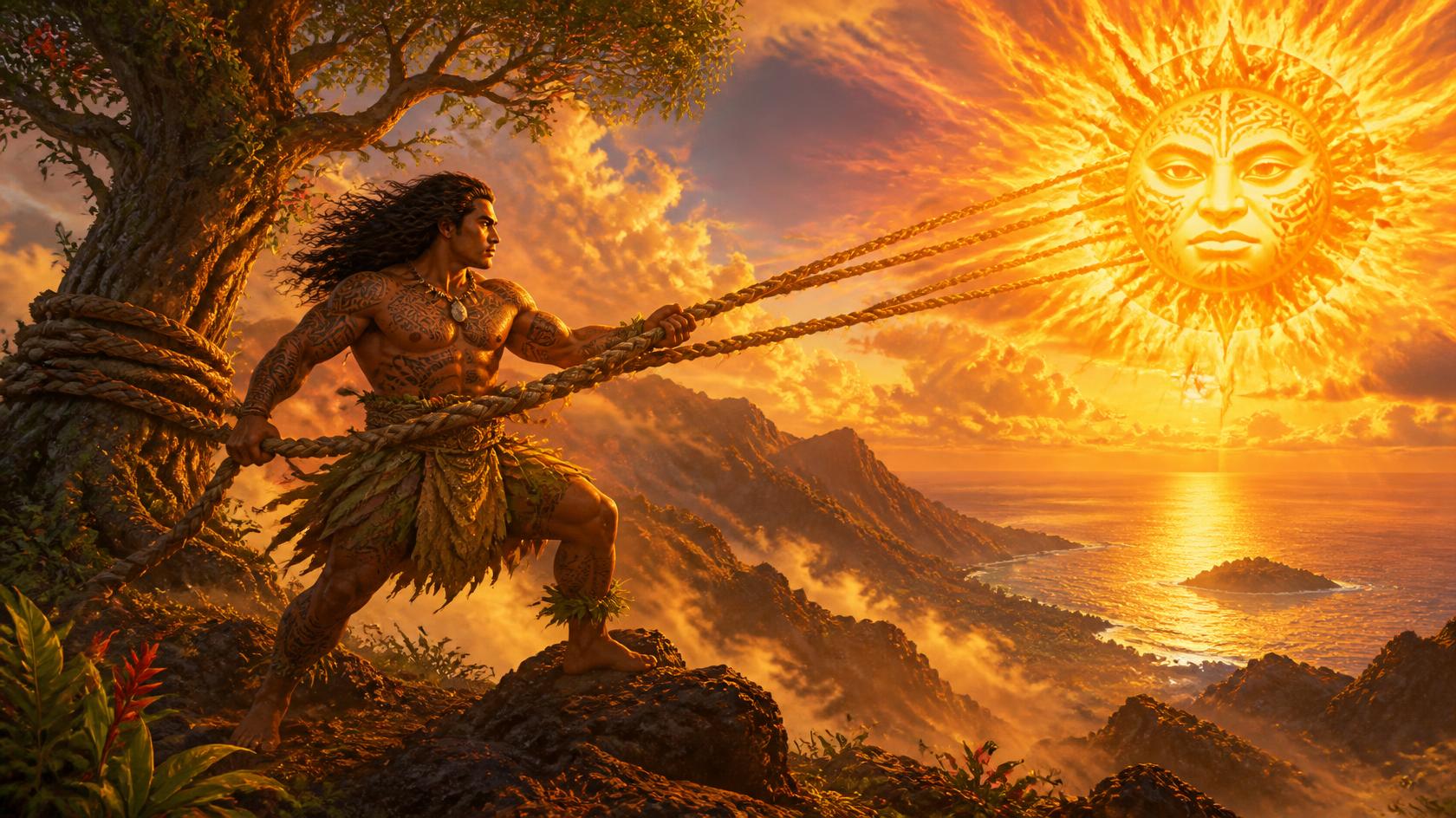
Maui sprang forward.
WHOOSH!
He threw his rope.
Got it!
The Sun tried to pull away.
Maui held on.
Then another ray appeared.
WHOOSH!
Maui caught that one too.
Then another.
And another.
One by one, the Sun's powerful rays were caught in Maui's ropes.
The Sun struggled.
He pulled.
He twisted.
He tried to escape.
But Maui and his brothers held the ropes tightly.
"Pull!" shouted Maui.
His brothers pulled.
"Harder!"
They pulled harder.
The Sun roared across the sky.
"What are you doing?"
Maui stepped forward, holding his magical weapon.
"You are moving too quickly!"
The Battle in the Sky
The Sun pulled with all his strength.
The ropes stretched.
The tree shook.
The ground trembled.
Maui held firm.
Then he raised his magical weapon.
THUMP!
He struck the Sun.
The Sun cried out.
THUMP!
Maui struck again.
"Slow down!"
THUMP!
The Sun struggled.
"Please!" he cried. "Let me go!"
Maui lowered his weapon.
"Will you promise to slow your journey across the sky?"
The Sun hesitated.
"If I slow down, I cannot travel as I always have."
Maui shook his head.
"You don't need to stop. You only need to give people enough time to live, work, grow their food, and enjoy the light."
The Sun thought about this.
At last, he agreed.
"Very well. I will slow down."
Maui loosened the ropes.
The Sun Learns to Slow Down
The Sun rose into the sky.
But this time, he did not race.
He moved slowly.
Steadily.
Gracefully.
For the first time, there was enough daylight for Hina to finish drying her kapa.
Farmers had time to work.
Fishermen had time to return home.
Food had time to cook.
Plants had time to grow.
And people had time to enjoy the golden light of day.
The Sun's Promise
From that day forward, the Sun kept his promise.
During some parts of the year, he traveled more quickly, and the days were shorter.
During other parts of the year, he moved more slowly, and the days became longer.
And people remembered the young hero who had dared to challenge the greatest light in the sky.
They remembered Maui.
The boy who looked at an impossible problem and thought:
"There must be a way."
And whenever the Sun rises over the mountains in a great golden glow, some say you can still imagine the faint marks of Maui's ropes stretching across the sky.
So, if you ever wake early enough to see the first light of morning, look carefully.
Perhaps you will see the Sun climbing slowly into the heavens.
And perhaps, just for a moment, you will hear Maui whisper:
"Take your time."
The Sun will shine.
The day will begin.
And somewhere beyond the mountains, Maui will be smiling.
Good night.